
See the breach path before an attacker does
KloudLytics maps the real path across your AWS account — from an internet-exposed resource, through your network and IAM, to a database or admin role. Every hop is a verified fact from your live configuration, not a hypothetical.
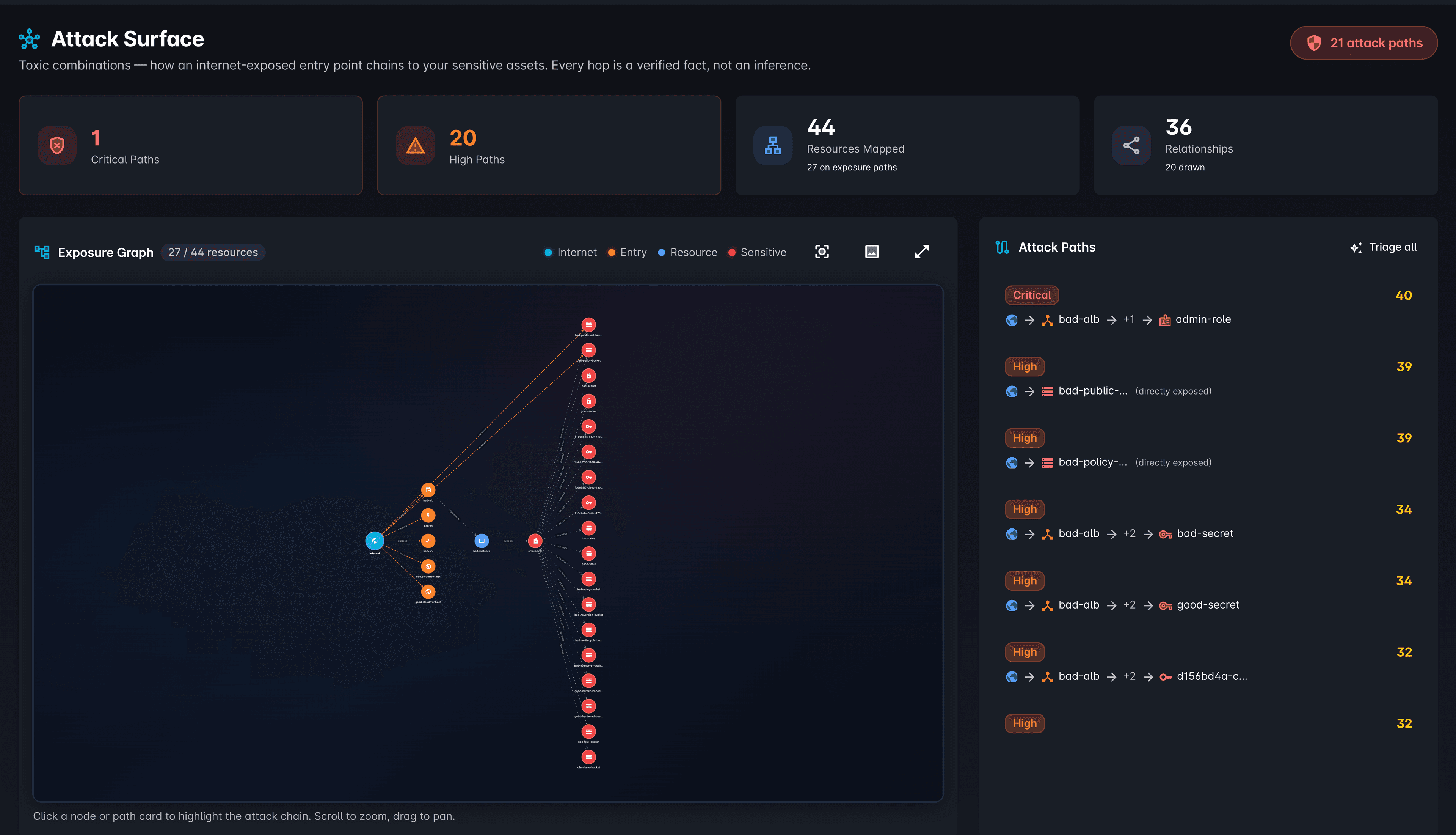
A breach is a chain, not a checkbox
Individual findings look medium. Connected, they’re how a real compromise happens. We trace the whole chain.
Internet exposure
Public S3, open security groups, exposed load balancers, endpoints, and instances — the ways in.
Network reachability
Route tables, peering, NAT, and security-group paths that actually connect the exposed edge to what's behind it.
IAM & privilege
Roles, trust policies, and permissions an attacker could assume or escalate once inside.
Impact
The database, admin role, or sensitive resource at the end of the path — where a breach actually lands.
Prioritize the exposure that actually unlocks something
Every hop is a fact, not a guess
Each step in a path is derived from your live AWS configuration — a real route, a real trust policy, a real exposed port. No hypothetical scenarios, no generic scare-graphs.
Ranked by exploitability & blast radius
Paths are prioritized by how reachable the entry point is and how much sits at the end — so you fix the one exposure that unlocks a database before the one that leads nowhere.
Context, not just red dots
A finding on a resource nothing can reach is de-prioritized; a compensating control (like a WAF in front) is noted. You spend attention on what's genuinely exploitable.
AI triage of the path
Each attack path gets an AI-written explanation of the chain and where to break it — turning a graph into a decision you can act on.
One agentless scan, the whole picture
Attack-surface mapping isn’t a separate product — it’s built from the same read-only scan that produces your posture score and findings. Connect a cross-account IAM role with a unique external ID, and KloudLytics assembles the graph from your live configuration. Nothing is installed, and no write permissions are ever requested.
Attack surface mapping — questions
What is attack surface mapping?+
It's the analysis of how an external attacker could move through your AWS account — starting from an internet-exposed resource and following real network and IAM connections to reach something valuable. Instead of a flat list of findings, you see the paths that actually chain into a breach.
How is this different from a normal findings list?+
A findings list tells you a bucket is public or a role is over-privileged in isolation. Attack-surface mapping connects them: it shows that the public bucket sits in front of a subnet that can reach a role that can read your database. The chain is what makes a set of medium findings a critical risk.
Are the paths real or hypothetical?+
Real. Every hop is derived from your live configuration — an actual route table entry, security-group rule, or IAM trust relationship — collected read-only via the AWS API. We don't invent attacker behavior; we surface the connections that already exist.
Does it reduce false alarms?+
Yes. Findings are put in context: an issue on a resource that nothing can reach is de-prioritized, and compensating controls are taken into account. That contextual risk scoring means the top of your list is the part that's genuinely exploitable.
Do I need to install anything?+
No. Attack-surface mapping runs on the same agentless, read-only scan as the rest of KloudLytics — a cross-account IAM role with a unique external ID. Nothing is deployed in your environment.
Find out what is actually exposed in your AWS environment.
Connect one AWS account and run your first security assessment.
No credit card · Agentless · Read-only